Product marketer for complex enterprise technology

Neysha Bauer
I build go-to-market strategies for the whole buying group, from practitioners evaluating how a product works to executives deciding why it matters, with messaging tailored to each audience.
My work spans AI, automation, security, cloud infrastructure, and developer platforms, focusing on translating technical capability into the right story, proof, and experience for each audience and market context.
Red Hat · ex-AWS · 10+ years in enterprise technology · Bilingual English & Spanish
About
I’ve built my career around making complex products clear, relevant, and grounded in real buyer challenges.
I started in analytics and industry marketing, where I learned to understand customers, partnered closely with sales, and turn technical priorities into growth-driving programs. At Red Hat, that work moved closer to product-led growth, first building regional GTM programs and buyer experiences around OpenShift, and now for Ansible.
My background in analytics, industry marketing, and go-to-market strategy still shapes how I work today: curious about the customer, close to the field, and always looking for the clearest way to connect a product to the problem it solves, and who it solves it for.
The open source world has also reinforced the kind of leadership I value: confident enough to contribute, humble enough to listen, and focused on building something larger than myself.
Featured Projects
Positioning · Market Entry · Excutive Value

Shift security automation into an AI era conversation
+88%
MS OPP VALUE YoY
+19%
MS WON VALUE YoY
The Challenge: Ansible Automation Platform has traditionally been known for infrastructure automation. As the portfolio expanded into broader orchestration, security automation, and AI-era use cases, we needed to reach new buyers without losing the technical credibility Ansible was known for. That meant building a story that could work at multiple levels: technical practitioners needed to understand how the platform solved real operational problems, while executive audiences needed a clearer view of business value, risk, governance, efficiency, and ROI.
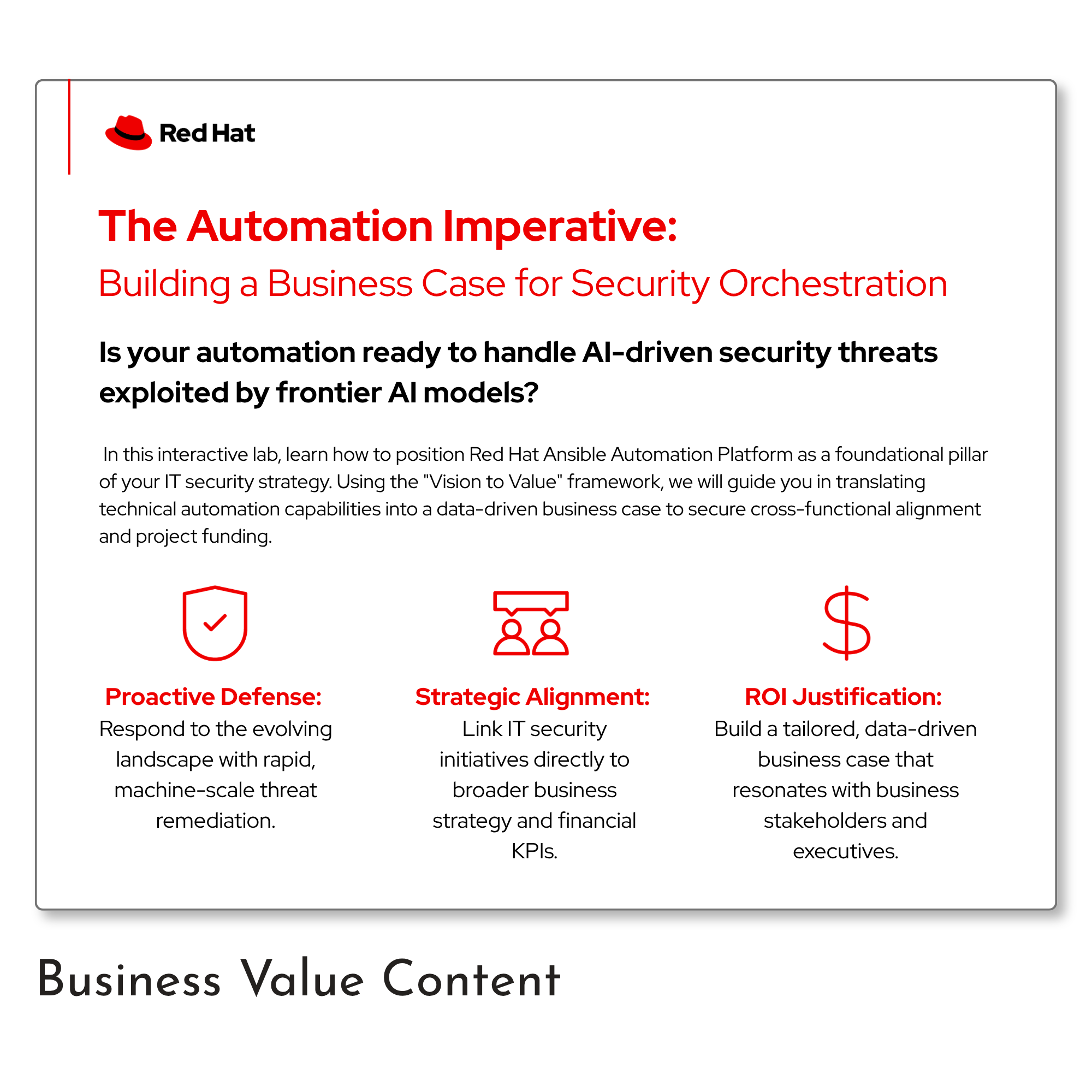
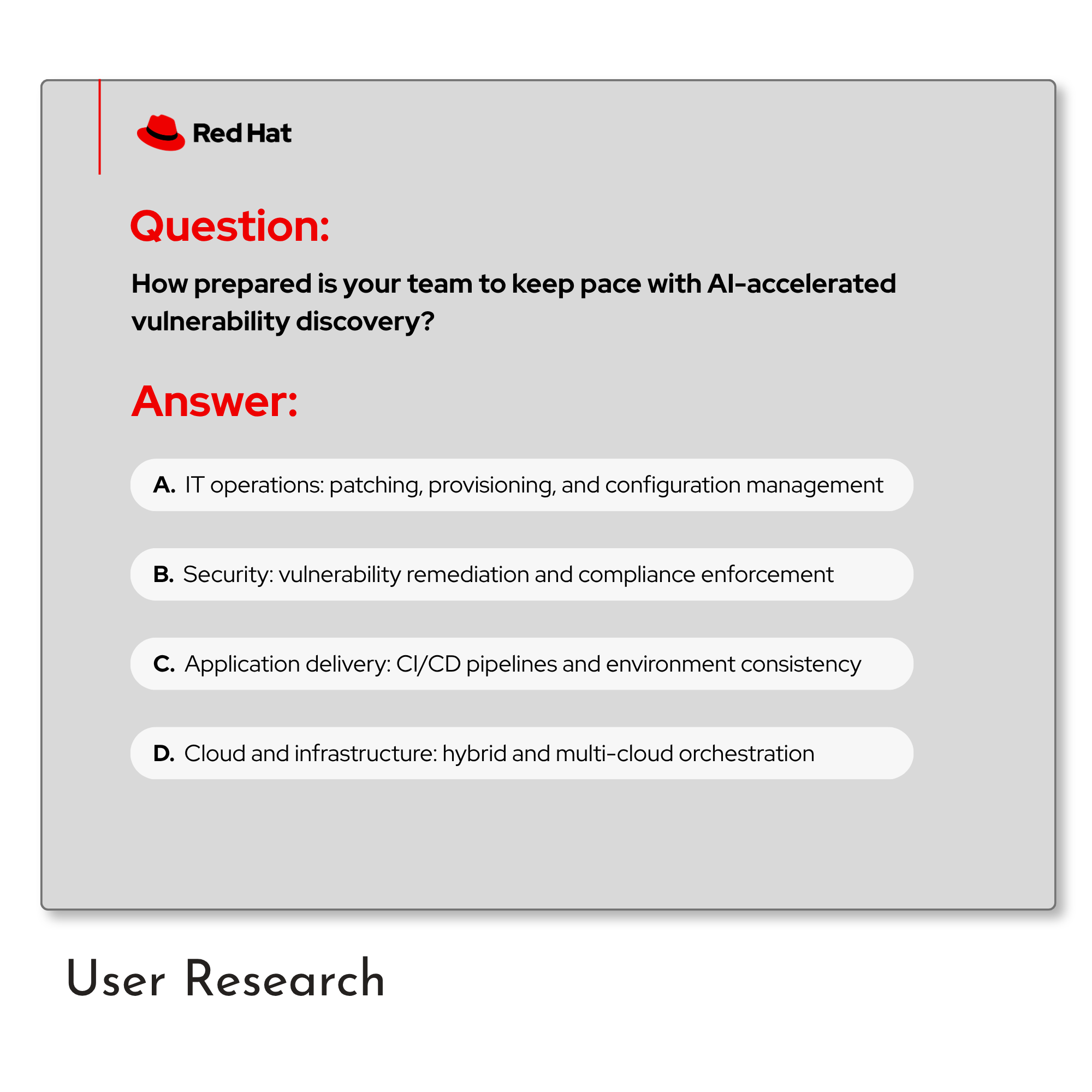
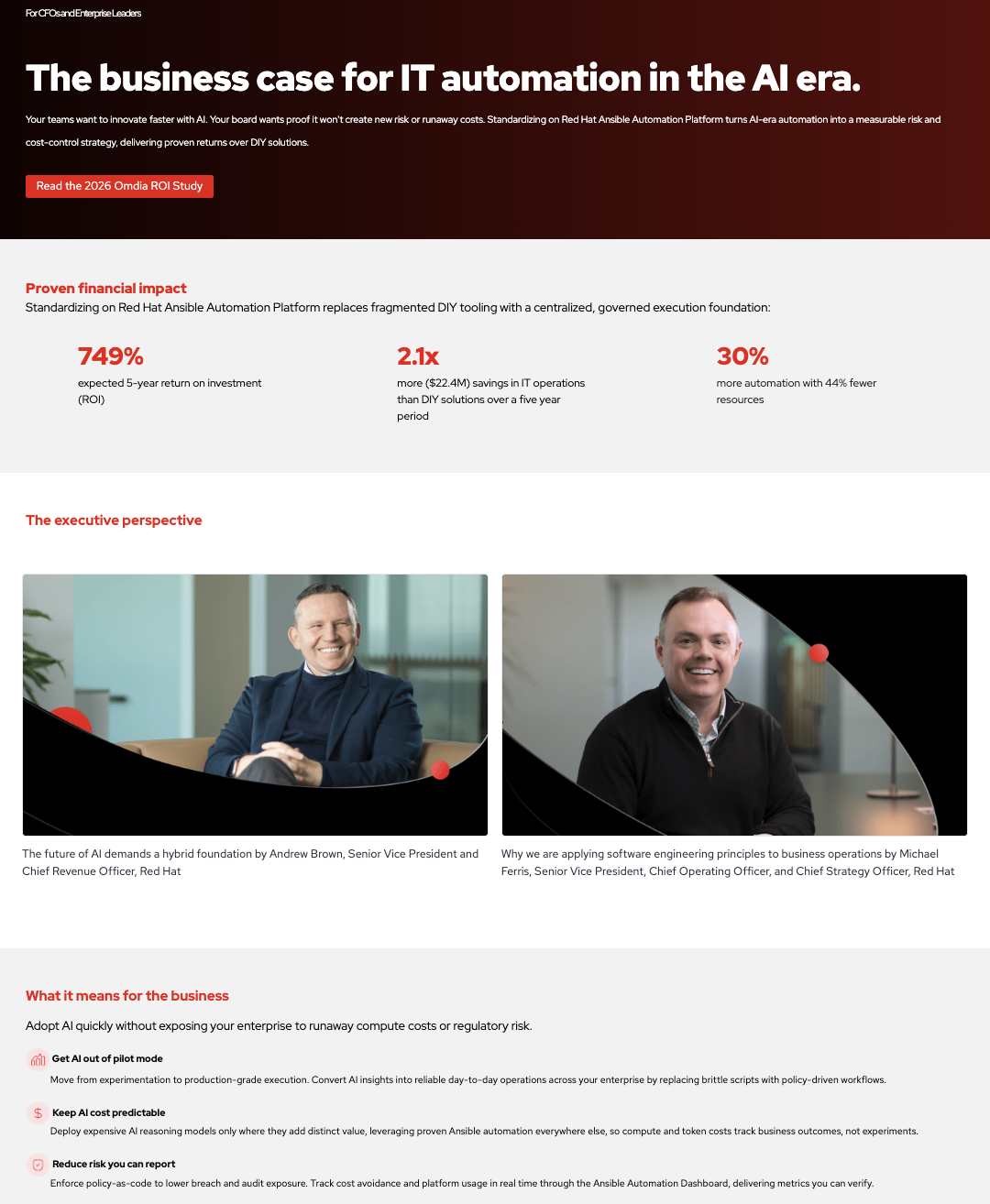
The Strategy: I led North America marketing strategy across emerging Ansible use cases, using buyer and persona research to reshape how we brought, and continue to bring, the platform to market. For security and IT audiences, that included developing regional messaging, field and MDR enablement, audience development, partner positioning, and new business-value content connecting security orchestration to the problems buyers were trying to solve. In parallel, I developed executive messaging and buyer journeys for CEO, CFO, CTO, CIO, and CISO audiences, translating the same platform capabilities into business outcomes and clearer paths to ROI.
The Result: Year to date, Security Automation use cases have driven an increase of 88% YoY in marketing-sourced opportunity value and 19% YoY in marketing-sourced won value, providing an early signal of increased adoption as the use case grows within the Ansible portfolio. The broader positioning work has also created a repeatable framework for tailoring Ansible’s value story across technical and executive audiences.
Buyer Journey · Technical Validation

Turning a buyer journey into a repeatable playbook
1,400+
2x
MORE MS OPP VALUE vs.
COMPARABLE PROGRAMS
INQUIRIES GENERATED
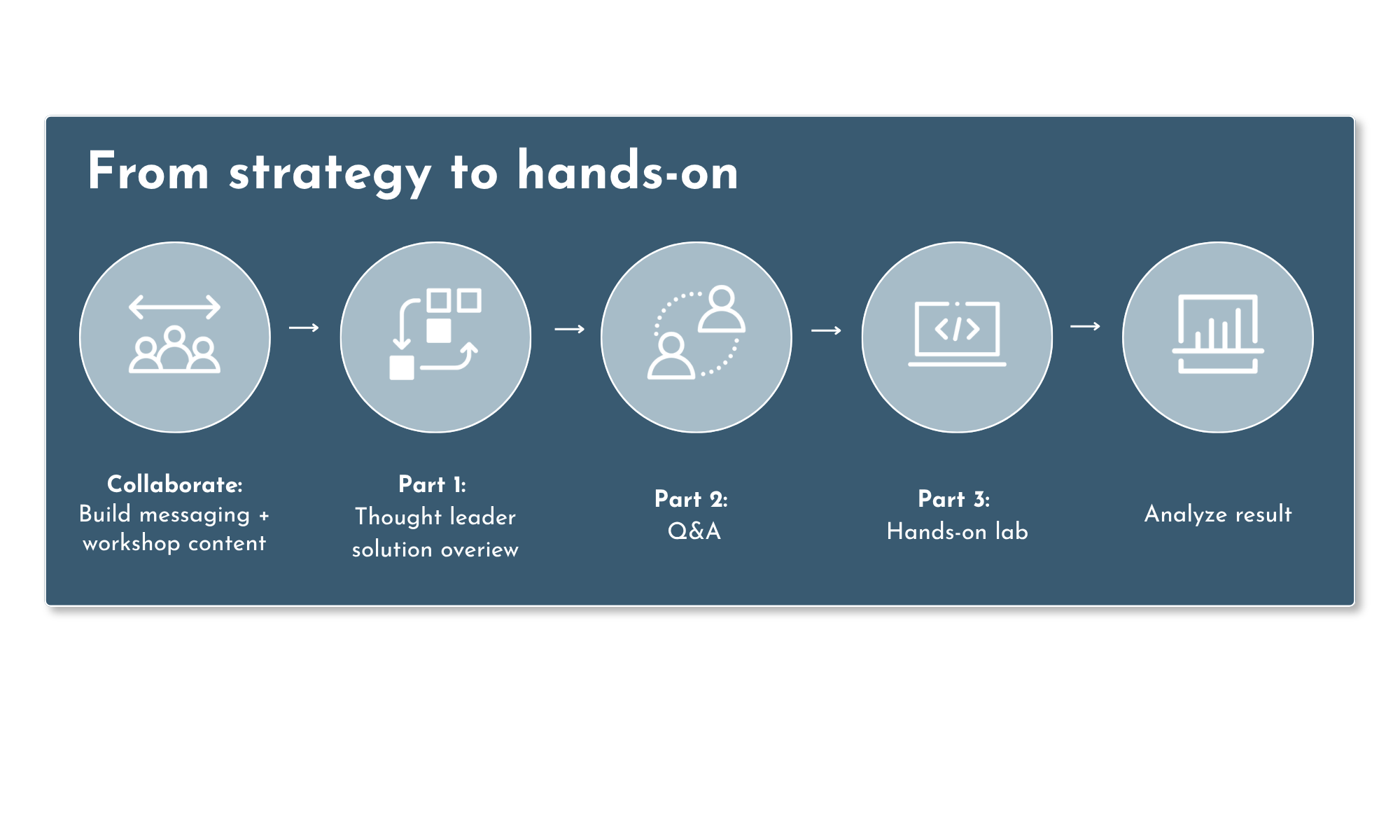
The Challenge: As we expanded into new automation use cases, we needed to reach more than technical practitioners. Business leaders needed to understand why a solution mattered, while technical buyers needed a way to validate how it worked. Those experiences were often happening separately.
The Strategy: I designed a dual-audience motion that connected the two, moving buyers from product and business-value discovery into hands-on technical validation in the same day. We piloted the approach with Network Automation, then adapted it for zero trust, creating a framework that could flex across use cases without rebuilding the journey from scratch.
The Result: The Network Automation and zero trust pilots generated 1,400+ inquiries and roughly 2× the marketing-sourced opportunity value of comparable programs. The framework is now being documented for reuse across North America.
Product Launch · Ecosystem Alignment

Launching a new virtualization offer into the North American market
STRONG 2025
PIPELINE PERFORMANCE
OVE-related offers became some of OpenShift’s strongest MS Opp Value drivers.
The Challenge: Red Hat OpenShift Virtualization Engine (OVE) was a new offer entering a crowded virtualization market. North American buyers needed to understand where it fit and why it mattered, while the field needed the education and content to take the new offer to customers.
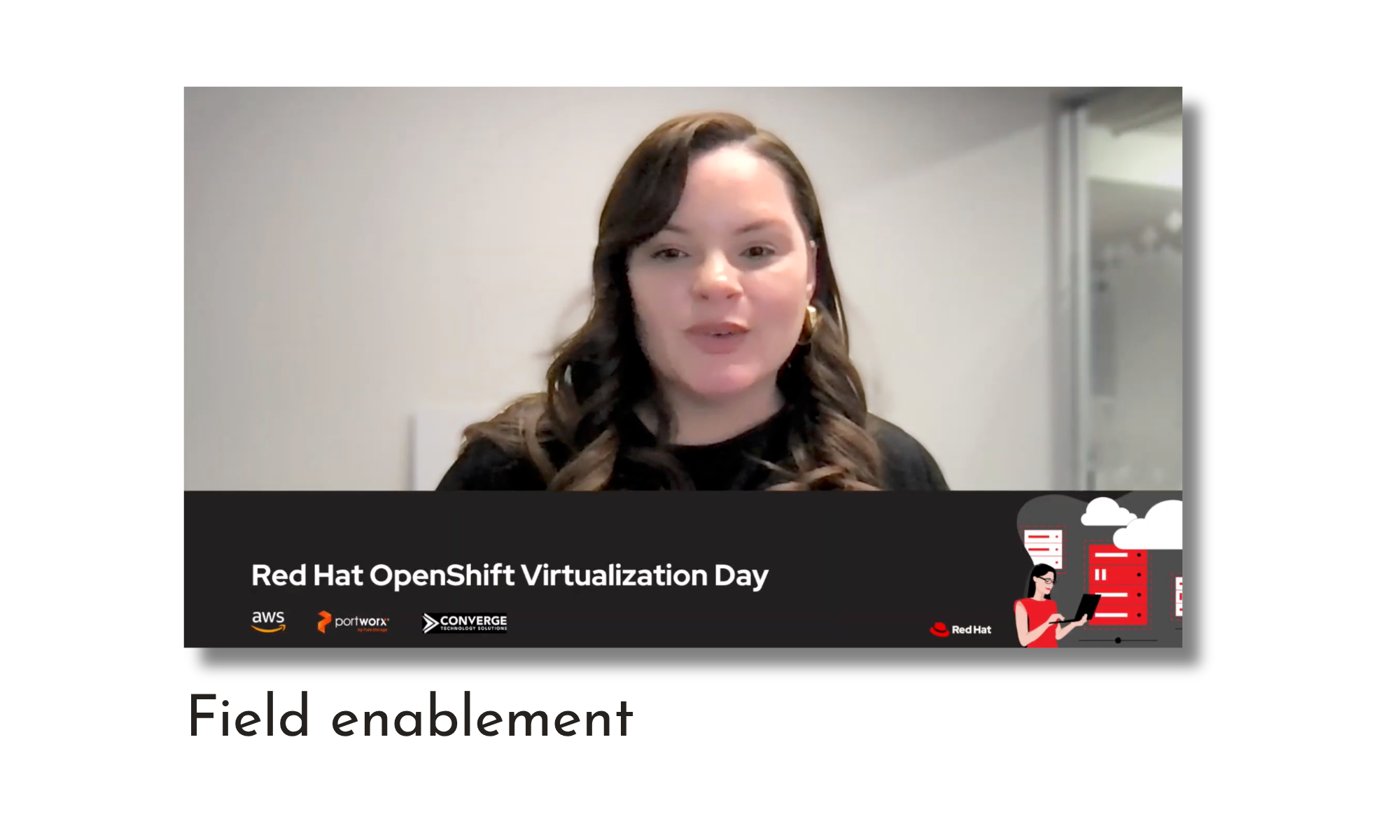
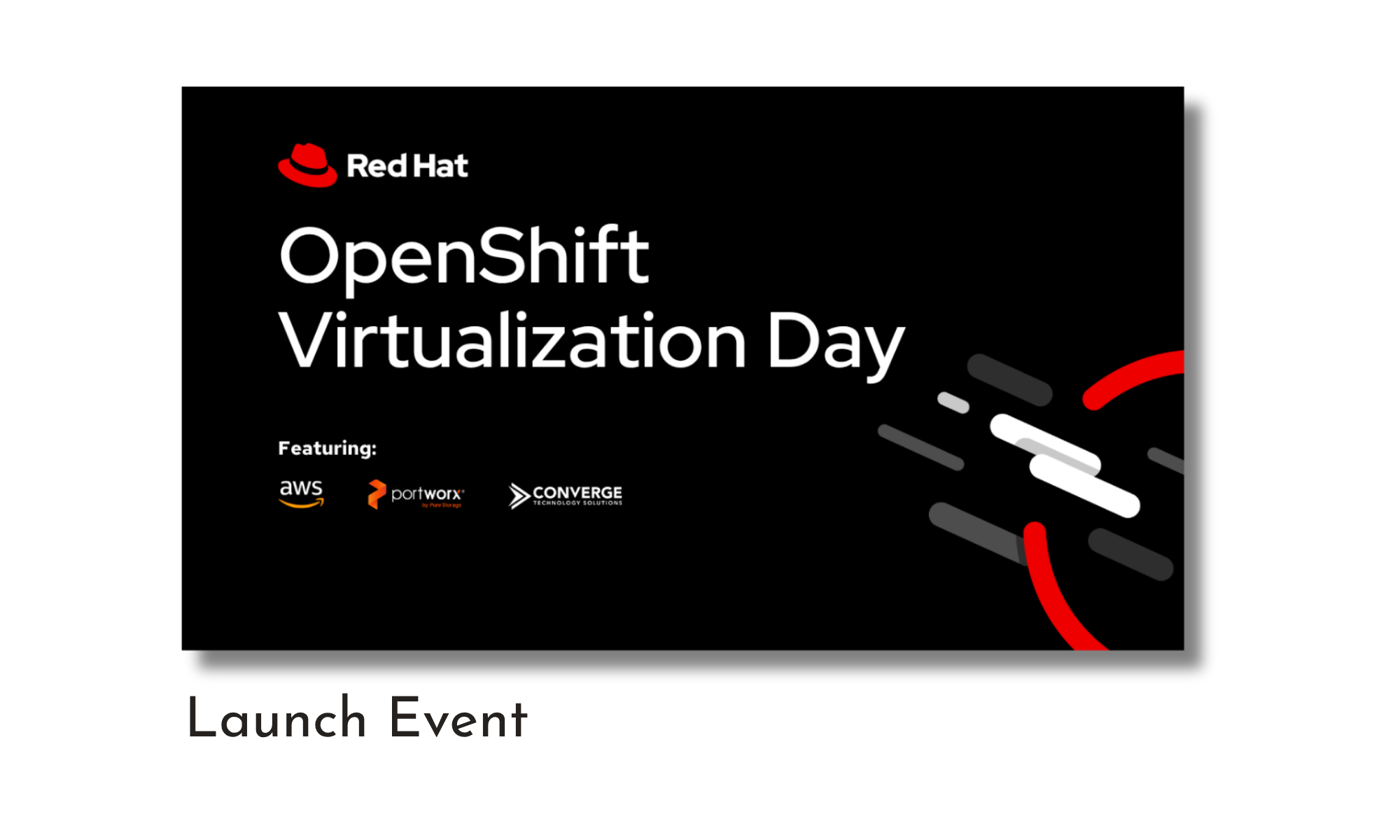
The Strategy: I built the North America launch plan across field enablement, buyer education, campaign offers, partner participation, and hands-on migration content. The launch connected initial product discovery with deeper technical evaluation through a three-session virtual launch event and follow-on migration workshop.
The Result: OVE-related offers became some of the strongest OpenShift pipeline drivers in 2025. The launch program also drew 393 registrations.
Developer Platforms · Scalable Playbook

Scaling hands-on technical education across a product portfolio
SHORTER TIME TO CLOSE
67%
MORE MS OPP VALUE YoY
2.9x
2.3x
MORE MS WON VALUE YoY
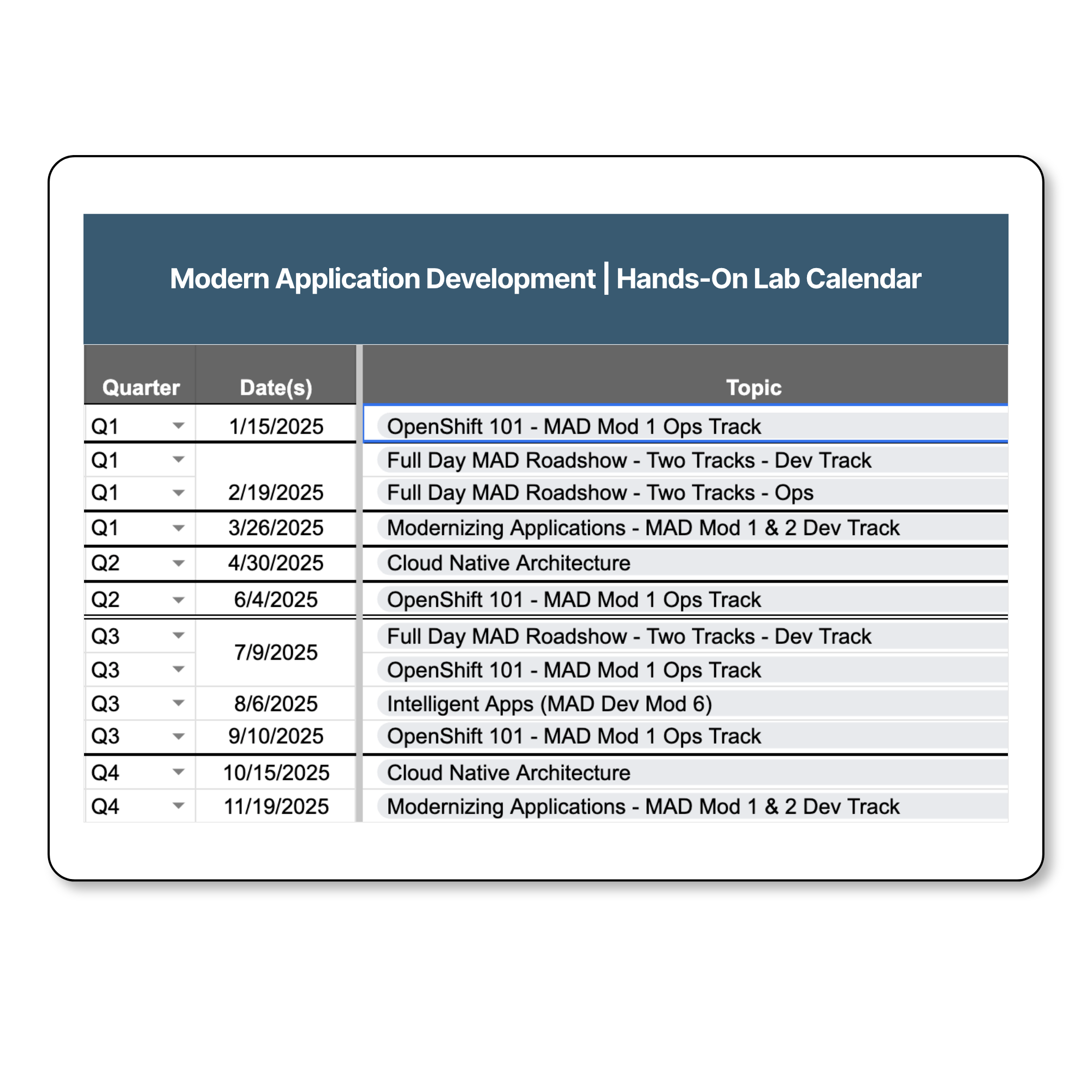
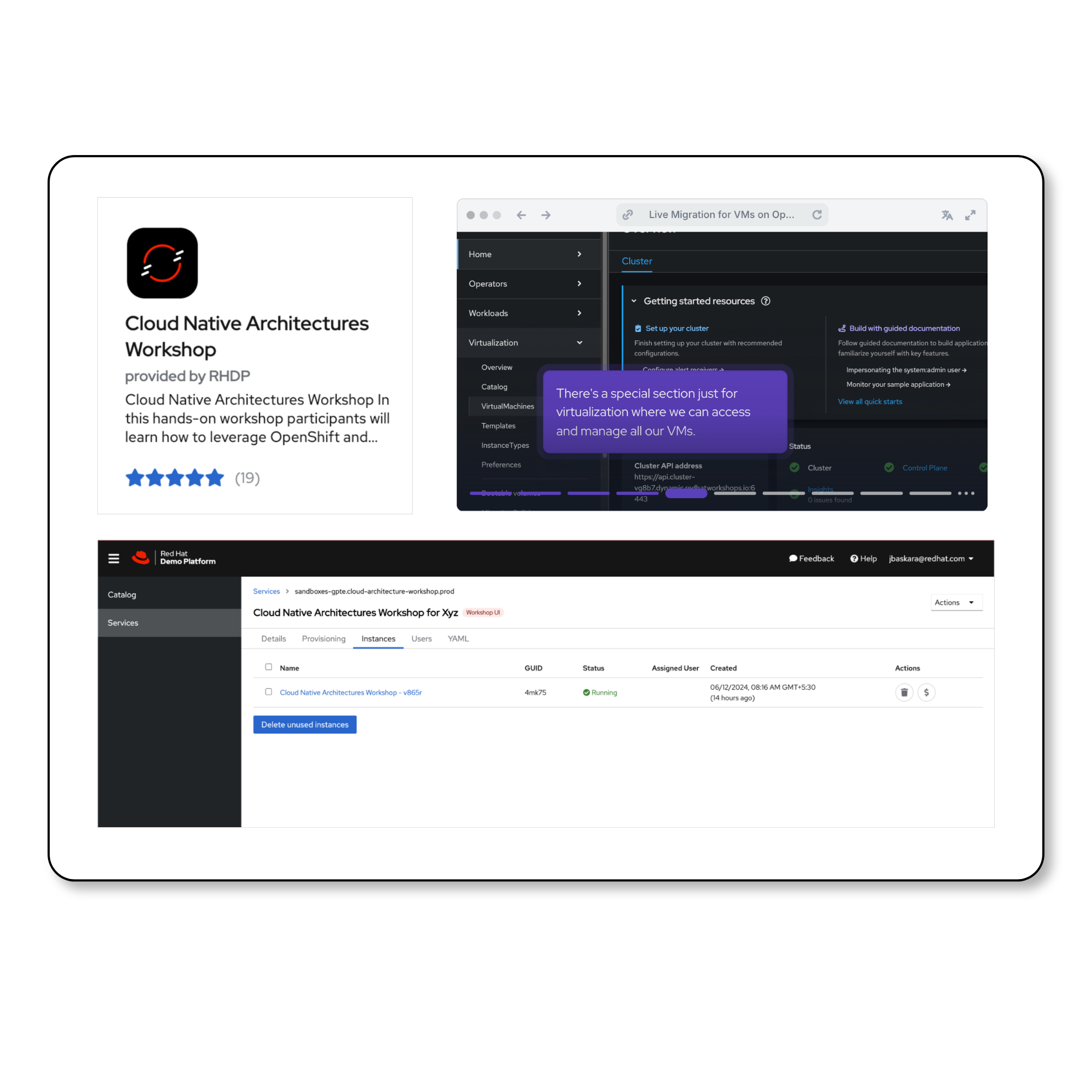
The Challenge: Hands-on technical education was valuable for OpenShift buyers, but individual product teams were repeatedly building their own programs to deliver it. We needed a model that could scale across the portfolio without making the product experience generic.
The Strategy: I created Workshop Wednesdays as a shared framework for hands-on product education, owning the series structure, calendar, brand, reporting, and portfolio coordination. Product teams retained ownership of their technical content, allowing the model to support different products and use cases while giving practitioners direct experience with the technology.
The Result: Opportunities associated with workshop attendees had a 67% shorter time to close than the typical opportunity cycle. The program also grew to drive 2.3× more MS Opp value and 2.9× more MS won value YoY from 2023 to 2024.
Applied AI
AI helps me turn intention into action.
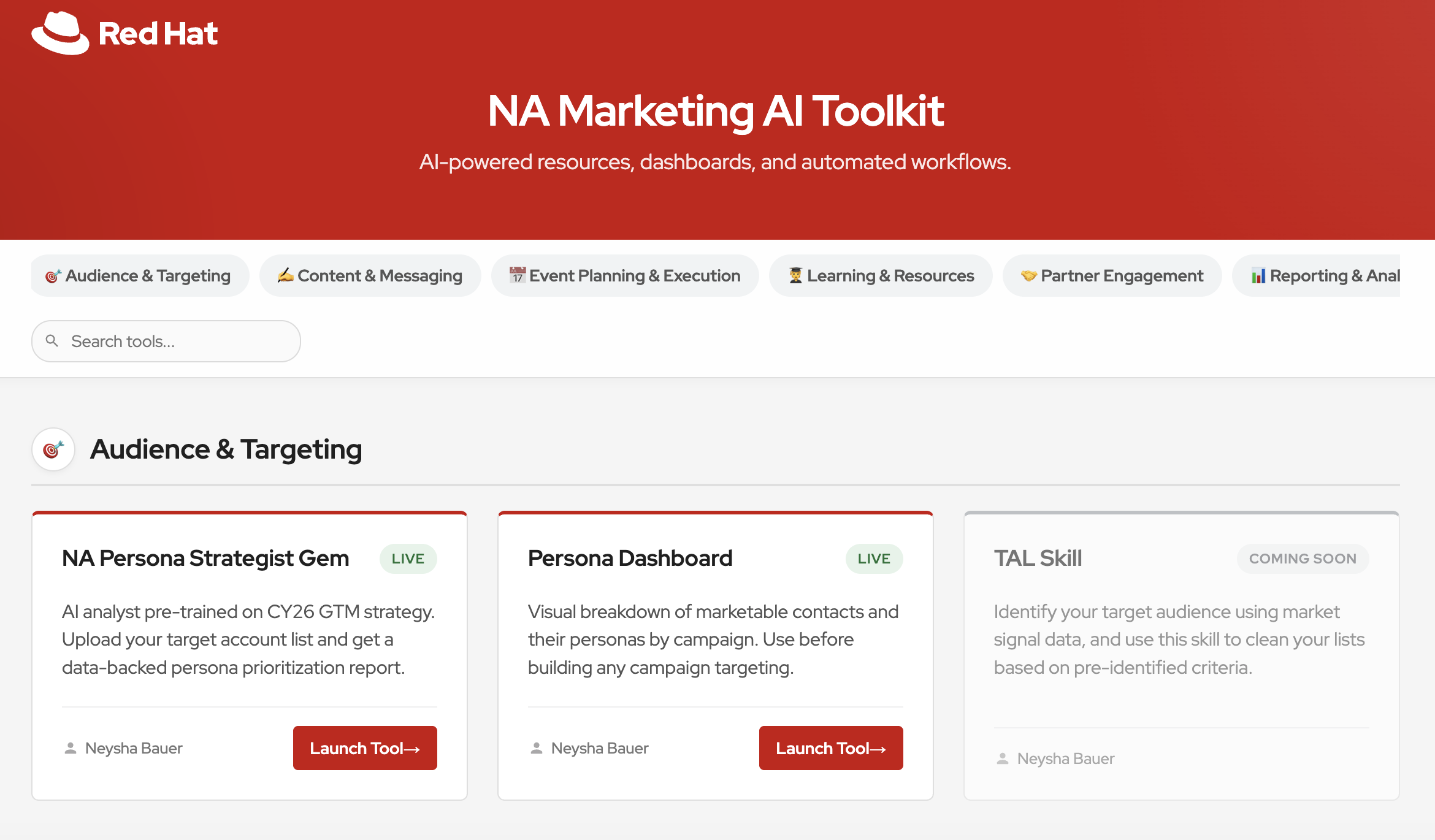
In 2026, I was selected as one of three AI Navigators within Red Hat North America Marketing, focused on finding practical ways to operationalize AI across everyday marketing work.
I build agentic workflows that connect planning, performance data, account context, and live Google Workspace files, using tools such as Cursor, reusable skills, persistent context, and tool calling.
My work has included AI-assisted planning and market analysis, workflow automation, internal tools and reusable skills, performance reporting, and systems that can draft or update live Docs and Sheets rather than stopping at a chat response.
The goal is simple: automate the repetitive parts of marketing so people have more time for strategy, creativity, and decision-making.
This work, together with my broader Ansible program contributions, supported recognition with a Q2 North America Marketing Excellence Award.
How I Got Here
-
Helped launch ID Agent, now part of Kaseya, when the business was still centered on dark web monitoring. I built the company’s first website and worked on a two-person marketing team, which taught me how to move quickly, trust my instincts, and make limited resources go further.
Inbound leads increased 20% in less than a year.
-
Moved into enterprise marketing analytics, working across a portfolio of brands and learning how to connect campaign and point-of-sale performance to business decisions.
I also built training for Fishbowl’s email and analytics tools and spent six weeks in New Delhi training a team of builders and analysts.
-
I caught the data bug and joined Hilton’s Customer Analytics team after completing a data analytics certification.
Working with larger data sets and presenting findings to VP and SVP stakeholders taught me how to turn analysis into a story people could act on.
I realized I didn’t want to be a data scientist. I wanted to be the most analytical marketer in the room.
-
AWS brought me back to technology and introduced me to cloud infrastructure, infrastructure as code, and a deeply customer-first way of working.
I partnered closely with field teams, developed customer stories, and built regional activations across the US. AWS also taught me that data only tells part of the story. I learned to pair performance with what I was hearing from the field and from customers: who the product was built for, what they cared about, and why.
It was also where I learned to operate in ambiguity, make decisions with incomplete information, and stay close to the customer while working at scale.
-
This was the start of my open source era, and the point where I shifted from industry marketing into deeper product and portfolio work.
Instead of building campaigns across multiple industries, I became hyper-focused on a defined solution suite, learning the product, the buyers, and the technical use cases in much greater depth.
Working in open source also changed the way I think about leadership. Building in public requires both confidence and humility: contribute what you know, listen when you don’t, and remember that the thing you’re building is bigger than you.
-
Moved from OpenShift to Ansible and into a broader automation story spanning AIOps, orchestration, and security.
My work now centers on defining the regional market-entry story for security automation in the AI era, understanding the buyers we need to reach, and turning that into repeatable approaches across launches, sales enablement, account strategy, and demand.